Before the Switch: A Brief History of Domestic Lighting
Domestic lighting history shows how candles, gas and electricity reshaped household routines, revealing why the light we expect at home still follows old habits.
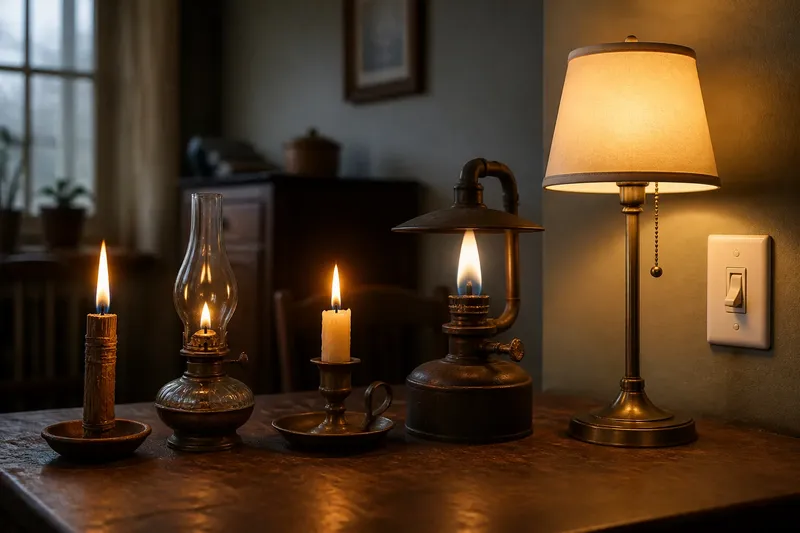
The common mistake in domestic lighting history is to imagine a clean handover: candles went out, electric lamps came on, and household routines barely changed. In practice, sources overlapped, and each one altered where people gathered, what they did after dark and how they arranged a room.
Following the changes through ordinary objects makes the story less like a parade of inventions and more like a record of adjustments at home.
What did flame ask a household to do?
Households used several forms of flame, including rushlights, oil lamps, tallow candles and beeswax candles. Their materials and upkeep differed, but each required attention. Someone had to prepare or trim a wick, replenish fuel, keep the flame clear and avoid leaving it unattended.
A lamp could be carried close to a task; a candle on a table could mark a place for reading, mending or eating. The small area it illuminated left other parts of a room dimmer. Rather than expecting even light throughout the home, people often brought their work towards the source.
A flame could extend the evening, but it also called for fuel, labour and care. These demands shaped when people lit a room and when they put the source out.
How did candles and oil lamps affect evening routines?
Candles and oil lamps varied in how they burned and in the attention they needed. The experience depended on the fuel, the lamp or candle, household resources and local availability. It is safer to describe these as differing options than to suggest that one improvement reached every home or made light uniformly cleaner or more dependable.
Even when a source worked well for a particular household, it did not remove the work of tending it. A lamp needed filling and a wick needed care; the flame still had to be watched. A change in the source could make a task more comfortable without remaking the whole evening.
Imagine, as an invented situation, a household replacing a smoky oil lamp with another lamp suited to its fuel. The starting point is a family reading and sewing near a lamp that bothers them; they replace the lamp and keep the same table routine. The expected observable result is a more comfortable task if the new lamp produces less smoke, while the need to fill and tend it remains.
What did gas lighting change inside the home?
Where a gas supply reached a home, a fixed burner connected by pipes could provide light at a chosen point without carrying a flame from room to room. The fitting belonged to the building, and its position could influence where people gathered or placed furniture.
Gas lighting still required attention and suitable upkeep. Its use depended on local supply, the building and household circumstances, so it was not a universal stage that every home passed through. The shift was as much about where a light source sat as about how it was fuelled.
Why did electricity change the meaning of a switch?
Electric lighting separated the visible flame from the act of producing light. A switch let someone turn on a lamp without preparing fuel or tending a wick. That smaller gesture made illumination easier to call for at a chosen point in the room.
Adoption depended on wiring, supply, building conditions and what a household could manage. Electric light might arrive alongside candles or other sources rather than replacing them at once. The switch changed how people accessed light, but it did not decide where a fitting belonged or make every corner equally clear.
What changed besides the source of light?
Electric fittings became part of a home’s infrastructure. A candle could be carried and stored; electric light relied on wiring and a supply beyond the room. The visible task of tending a flame receded, while care shifted towards bulbs, fittings and, where needed, electrical work.
Light could also become less noticeable as a household activity. A person might turn on a room before beginning a task rather than bring a flame close to it. Yet a lamp’s position still affected where people read, worked or sat together.
How does domestic lighting history explain habits that remain?
Some familiar habits still treat light as a companion to a task: switching on a lamp to read, or turning it off when leaving a room. These choices reflect both practical routines and expectations formed as lighting sources changed.
The difference is like using a kettle on a hob beside an electric kettle. Both serve a similar purpose, but one makes the process more visible and asks for more involvement. Lighting sources differ in the same way: the work can become less apparent without disappearing from the home entirely.
Did every household move from candles to gas and then electricity?
No. Sources overlapped, and access depended on local supply, buildings and household circumstances. A home could use more than one kind of light at a time.
Why might a household keep candles after adopting electric light?
Candles could remain familiar or useful as portable light, while electric service was not available or dependable everywhere. Their continued use shows that a new source did not immediately erase older routines.
Did electric light make every room bright?
No. The result still depended on the lamp, its position and the room. A switch made light easier to access, but it did not illuminate every part of a home equally.
What changed most in domestic lighting history?
Both the tools and household expectations shifted. The history is not just about different sources; it is also about changing routines and where the work of providing light took place.
The next time you switch on a lamp, notice how little preparation the gesture asks of you. Domestic lighting history helps explain that ease, but it also leaves a useful reminder: even a readily available light works best when its position suits the task at hand.